Evidence analysis for criminal defense
The report said one thing. The bodycam said another.
Upload bodycam, dashcam, jail calls, and 911 audio. TrueLaw produces a timecoded, speaker-labeled transcript, places it beside the officer's written report, and surfaces the passages where the two accounts diverge — for you to evaluate. Click any quote and you land on the words it came from. Click any timecode and the video seeks to that second.
TrueLaw is software. It is not a substitute for the advice of an attorney. Every output is a draft for a licensed attorney to review, verify, and decide whether to use.
For licensed attorneys. Every output is a draft for attorney review.
The rule it is held to
If TrueLaw can't show you where something came from, it won't show it to you.
A finished first pass, as it appears in the app
- Source3 sources readdone
- Words3 of 3 pairsdone
- Finding4 contradictionsdone
- AuthorityNot in this runnot part of this run
- DraftNot in this runnot part of this run
- AttestYou decideyours
3 of 3 source pairs compared · 4 contradictions
- Miranda advisement
police-report.txtLocatedQuote found word for word
Prior to any questioning I advised the driver of his Miranda rights
versusbodycam-transcript.txtLocatedQuote found word for word
no advisement of Miranda rights appears anywhere in this recording
- Basis for the stop
police-report.txtLocatedQuote found word for word
swerving repeatedly between the travel lanes and over the center line
versuswitness-statement.txtLocatedQuote found word for word
we were not swerving or anything like that, he was staying in the lane fine
2 more findings in the sample case
Built from the synthetic sample case every new account opens with: invented people, no client's evidence, and no model was called to produce it.
Three things it does, and how
Every finding is pinned to its source.
Every quote TrueLaw shows you is string-matched against the source text before it is displayed, down to the page or the second of the recording. If the passage cannot be found, the finding is stamped NOT LOCATED and no highlight is drawn.
Citations are retrieved, or held back.
Each case citation in a draft is matched to a retrievable opinion in CourtListener, a public database of court opinions. A citation that cannot be retrieved is held back from the draft. Not a citator — good-law status is yours to confirm. Nothing exports until a licensed attorney attests they have reviewed it, and the attestation is recorded with the export.
The work is a record.
Each file gets a sha256 hash recorded at upload, so you can show the file you analyzed is the file you received. Every AI step is recorded — what ran, with which model, on what input — and the steps are hash-chained, so a change made afterwards shows. Hashing documents integrity; authentication, foundation, and admissibility remain counsel's to establish.
What the first pass does on a new case
Start the first pass on a case and the agent works through the file and writes down every step:
- lists every source in the case;
- compares each pair of sources for passages that disagree;
- locates every quote in the source it came from, or marks it not located;
- lists evidence the file refers to that nobody produced;
- states how many source pairs it compared, and names any it did not.
It never writes a finding in its own words, files anything, or decides what matters. Those are yours.
The rest of the case, in the same place
Contradictions are where a case starts. These screens come from the same sample case: what an attorney sees on an ordinary morning.
Sample case — invented data
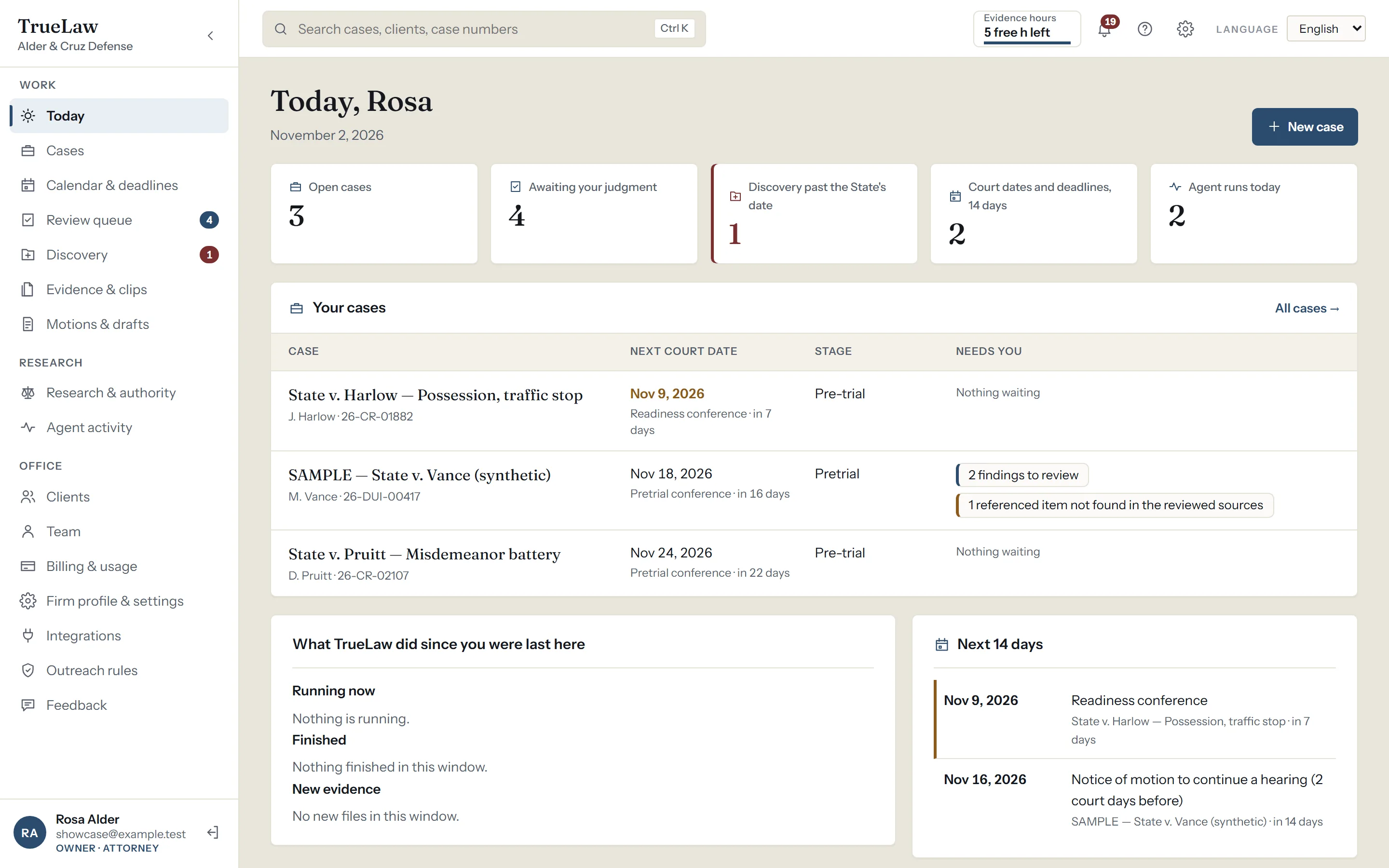
The morning view. Each open case with its next court date and what is waiting on you: findings to judge, discovery past the State's date, and deadlines in the next two weeks.
Sample case — invented data
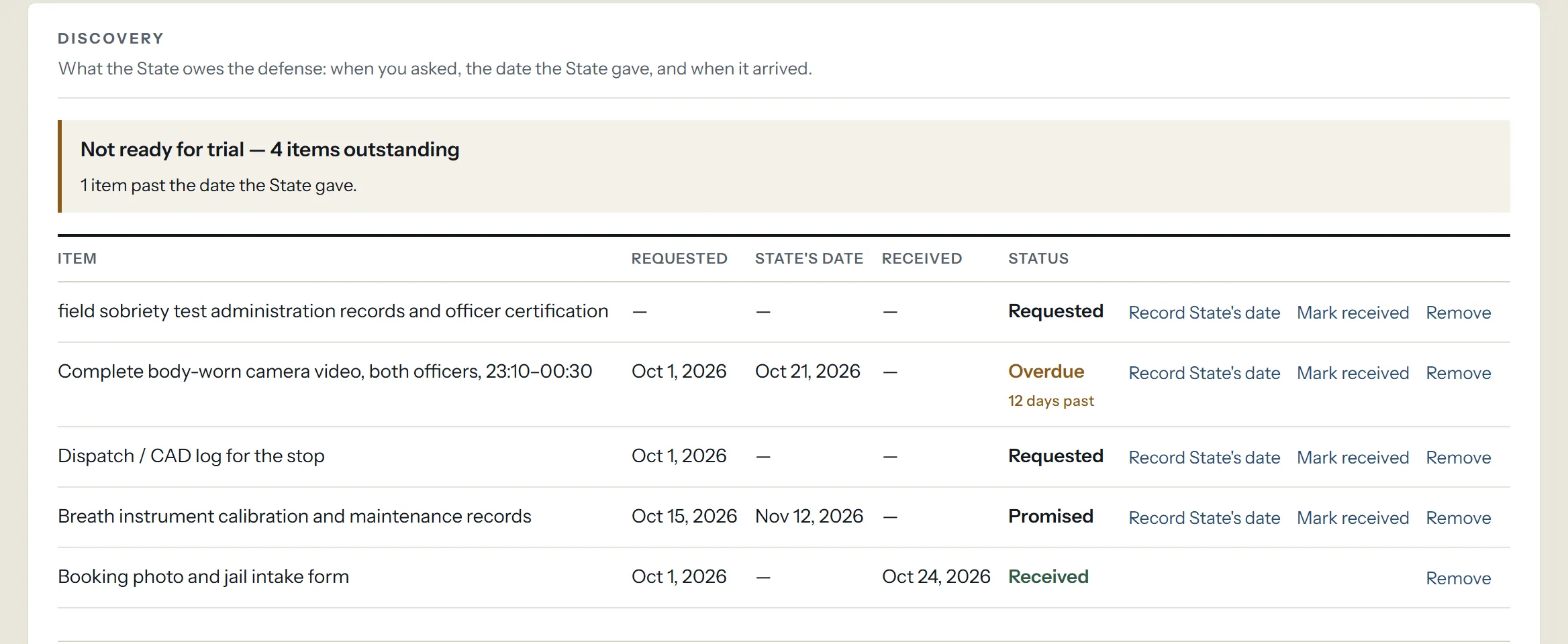
What the State owes you. When you asked, the date the State gave, and how many days past it they are. The letter, the motion to compel and the motion to continue are drafted from this ledger; nothing is filed or sent.
Sample case — invented data
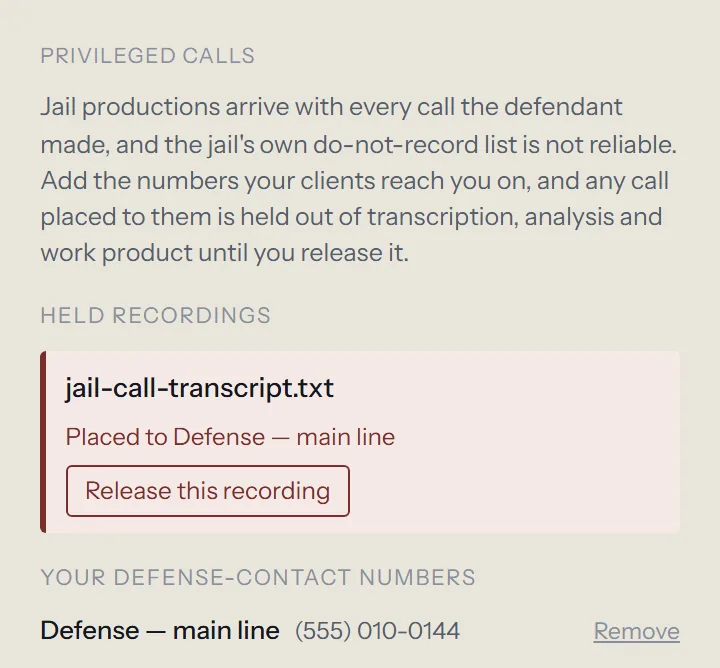
Calls to your office are held. A jail call placed to a number on your defense list is held before it is transcribed or analyzed. Only a member marked as an attorney can release it, and the reason is recorded.
Sample case — invented data
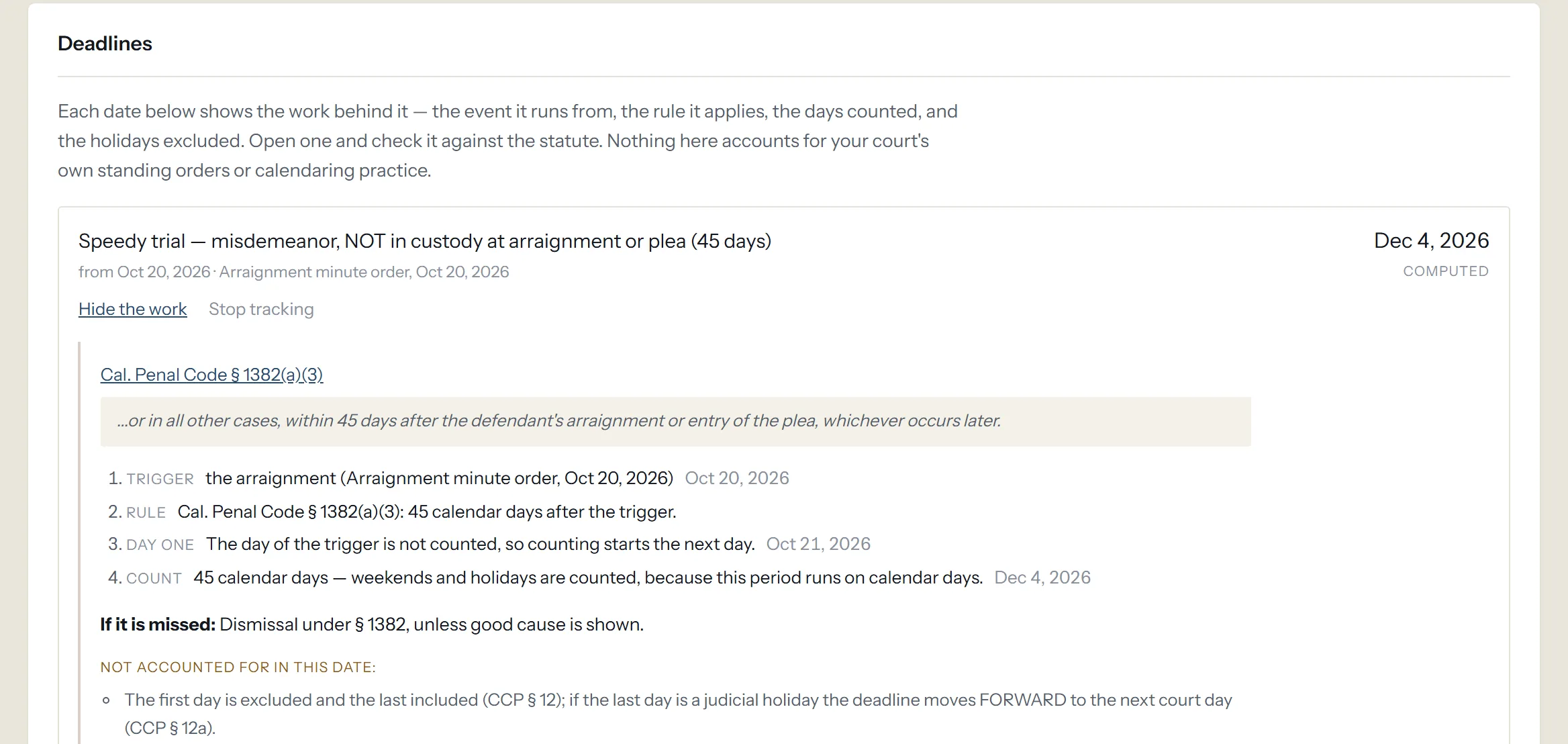
Deadlines that show their work. The statute and its text, the event the period runs from, the day counting starts, the count, and what the date does not account for, such as local court closures.
Sample case — invented data
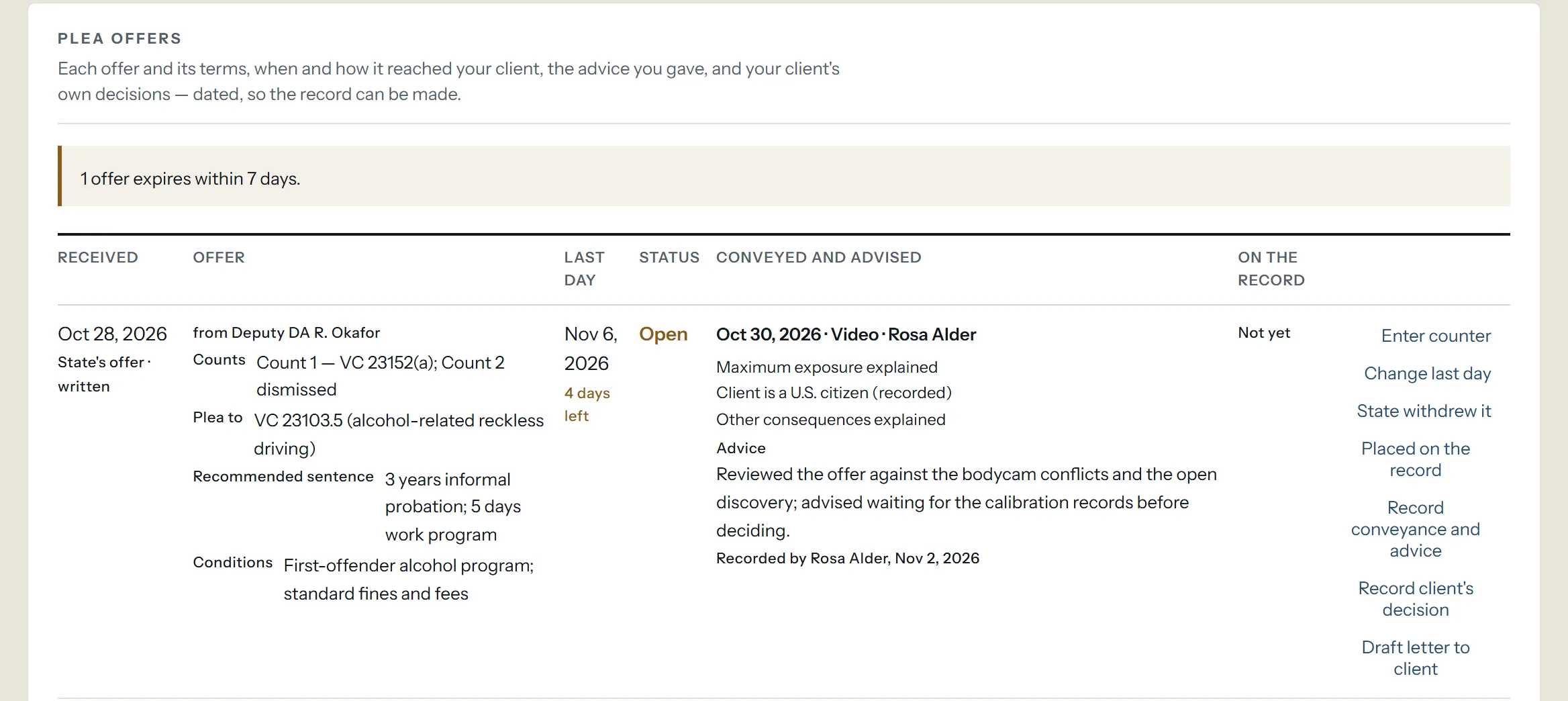
Every offer, and what you told your client. The terms, the last day, when and how the offer reached your client, and the advice you gave. Entries are dated and cannot be edited afterward; a change is a new entry.
Published prices
- Solo
- $199 a month
- For one attorney — up to 5 user accounts, staff included.
- Firm
- $189 per attorney, a month
- For firms of 2 or more attorneys.
Each plan includes evidence hours every month — 40 on Solo, 50 per attorney on Firm, pooled — and 30 agent runs a month (per attorney on Firm). One hour of audio or video, or 100 pages, is one evidence hour; each file counts once. Past the allowance and a grace margin, new uploads pause until the next month; everything already in your cases stays open.
Early access: online payment is not switched on yet. Signing up asks for no card, and nothing is charged.
Never a percentage of your fees, never tied to case outcomes.
What we don't claim
We don't publish accuracy percentages, because ours would come from cases we wrote ourselves. We don't tell you a motion is admissible, or that a case is still good law, or what a judge will do. We don't predict outcomes. This is not legal advice and it does not practice law — you are the final gate on every word.
TrueLaw is software. It is not a substitute for the advice of an attorney. Every output is a draft for a licensed attorney to review, verify, and decide whether to use.
Questions, answered
What is TrueLaw?
TrueLaw is software for criminal defense attorneys. It transcribes bodycam, dashcam, jail-call and 911 recordings, places them beside the police reports and other documents in the case, and lists the passages where the accounts disagree. Every quote it shows is located in the source it came from, down to the page or the second of the recording, or it is marked not located.
Who is it for?
Licensed criminal defense attorneys, solo and in firms, and the staff who work with them. Every output is a draft for a licensed attorney to review, verify, and decide whether to use.
Does it replace Clio, MyCase or other case-management software?
No. TrueLaw works on its own, next to the case-management software your firm already uses. It does not do time billing, client invoicing or trust accounting; those stay where they are. Direct connections to case-management systems are not switched on yet.
How does it show that a file was not changed?
The server computes a sha256 hash of each file as it receives it, stores the original encrypted, then reads the stored copy back and checks the hash before the file becomes evidence in the case. Every AI step is recorded — what ran, with which model, on what input — and the steps are hash-chained, so a change made afterwards shows. Hashing documents integrity; authentication, foundation and admissibility remain counsel's to establish.
What happens to a jail call with my client's attorney on it?
A call to a number on the firm's privileged list, or one flagged as a legal line, is held before it is transcribed. A call whose words read like an attorney call is held as soon as its transcript is made. A held call is not searched, compared or shown until an attorney releases it with a reason, and the release is recorded.
Can it invent a case citation?
Each case citation in a draft is matched to a retrievable opinion in CourtListener, a public database of court opinions. A citation that cannot be retrieved is held back from the draft. It is not a citator: whether a case is still good law is yours to confirm. Nothing exports until a licensed attorney attests they have reviewed it.
Where does the evidence go, and who sees it?
Evidence text and agent records are encrypted at rest (AES-256-GCM). Each firm's data is kept separate from every other firm's. AI processing is performed by third-party AI model providers under their API terms, through OpenRouter; TrueLaw does not currently hold a contract with every provider that bars training on, or retention of, what is sent, so consider this before you upload privileged material. No SOC 2 or ISO 27001 audit has been completed.
What if a protective order requires the discovery to be deleted?
An attorney records the order and orders the deletion. The case's files, clips and extracted text are removed or overwritten, the case's own encryption key is destroyed for what was sealed under it, and a deletion certificate lists each item by hash. The record of what was deleted, when, by whom and under which order is kept.
Does it predict outcomes or publish an accuracy rate?
No. It does not predict outcomes, does not publish accuracy percentages, and does not tell you a motion is admissible, that a case is still good law, or what a judge will do. You are the final gate on every word.
Is it available in Spanish?
Yes. The app and these pages can be switched between English and Spanish.
Open the sample case. Then start your own.
Every new account opens with the synthetic sample case and its finished first pass, so you can inspect the work before you upload anything.